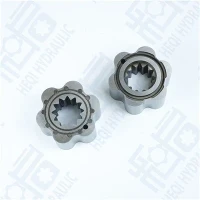
Gerotor Set For Steering Gear Unit
In orbital hydraulic motors and steering units, the stator–rotor pair is the core component responsible for energy conversion. Hydraulic oil flows through the chambers formed between the rotor and stator, and the resulting volume changes generate the force required for rotation or precise flow control. Two common designs are used: Gerotor and Geroler. While both operate on the same principle, their internal contact differs, leading to different performance characteristics. The Gerotor design is compact and widely used in smaller motors and steering systems, whereas the Geroler design reduces friction through rolling elements, making it more suitable for higher load conditions and improved efficiency and service life. In both cases, the machining accuracy of the stator–rotor pair is critical, as it directly affects sealing performance, efficiency, and overall durability.

- Product Introduction
In orbital hydraulic motors and hydraulic steering units, the rotor–stator set is one of the key internal components. It is the part where hydraulic oil actually does the work of creating motion. When oil flows into the chambers formed between the rotor and the stator, the volume inside these chambers changes during rotation. This change in volume produces the force that turns the motor shaft or meters the flow inside a steering unit.
Two structural forms are commonly used for this component: the Gerotor design and the Geroler design. They follow the same basic operating principle, but the internal contact between the rotor and the stator is different. Because of this difference, their behavior in real applications is not exactly the same.
The Gerotor structure is the simpler of the two. It uses an inner rotor that rotates inside an outer stator with one additional tooth. The rotor does not spin around its own center only; it also moves slightly in an orbital path inside the stator. As it moves, several sealed cavities are formed between the two parts. Hydraulic oil enters these cavities and forces the rotor to move, which is how rotational motion is produced.
In a Gerotor set, the rotor and the stator are in direct sliding contact. The teeth of the rotor follow the inner profile of the stator as the mechanism turns. From a manufacturing point of view this structure is relatively straightforward, which is why it has been widely used in many compact hydraulic components. The design is reliable and the size can remain quite small, making it suitable for equipment where installation space is limited.
The Geroler concept was developed later as a way to improve the contact between the moving parts. Instead of sliding directly against the stator profile, the rotor interacts with a series of small rollers that are positioned inside the stator ring. These rollers reduce the amount of friction that occurs during operation. With less sliding contact, the mechanism can operate more smoothly and usually tolerates higher loads.
Because of this difference, Geroler mechanisms are often preferred in hydraulic motors that work under heavier conditions. Construction machinery, winches, and various heavy-duty drive systems frequently use this design. In many orbital motors similar to the OMR, OMS, or OMT series, the Geroler arrangement helps improve efficiency and extends the service life of the motor when it is running under higher pressure.
Gerotor structures, however, still have an important place in hydraulic equipment. They are widely used in smaller orbital motors and in systems where compact design and cost efficiency are priorities. One area where the Gerotor mechanism is particularly common is hydraulic steering units.
Inside a hydraulic steering control unit, the rotor–stator set functions as a metering device. When the steering wheel is turned, the Gerotor set rotates and precisely measures the amount of oil that flows to the steering cylinder. This controlled flow is what allows the wheels of the vehicle or machine to turn smoothly and proportionally. The simple structure of the Gerotor mechanism makes it well suited for this task, and its compact size fits easily within the steering valve housing.
Although Gerotor and Geroler mechanisms share the same basic principle, their practical applications often depend on operating conditions. Systems that require higher load capacity and longer continuous operation tend to benefit from the Geroler structure. On the other hand, applications that focus on compactness, reliability, and cost control often use the Gerotor design. In either case, the machining accuracy of the rotor and stator remains extremely important, because even small deviations can influence sealing performance, efficiency, and overall durability.


Hot Tags: gerotor set for steering gear unit, China gerotor set for steering gear unit manufacturers, factory, hydraulic motor proportional valves, shell housing, hydraulic motor service parts, hydraulic motor fixed displacement parts, hydraulic motor package deals parts, hydraulic motor medium pressure parts